The Constant Quest for Fuel
Because their metabolic demand is so punishingly high, a hummingbird must consume up to half its body weight in nectar and insects daily to avoid starvation. They visit hundreds of flowers every single day, keeping a mental map of which blooms they have recently drained and which ones are ready for a refill. When nectar supplies run low or night falls, hummingbirds enter a state of deep sleep called torpor, dropping their body temperature and slowing their heart rate down dramatically to conserve energy.
Diversity in Scaling: From Bee to Giant
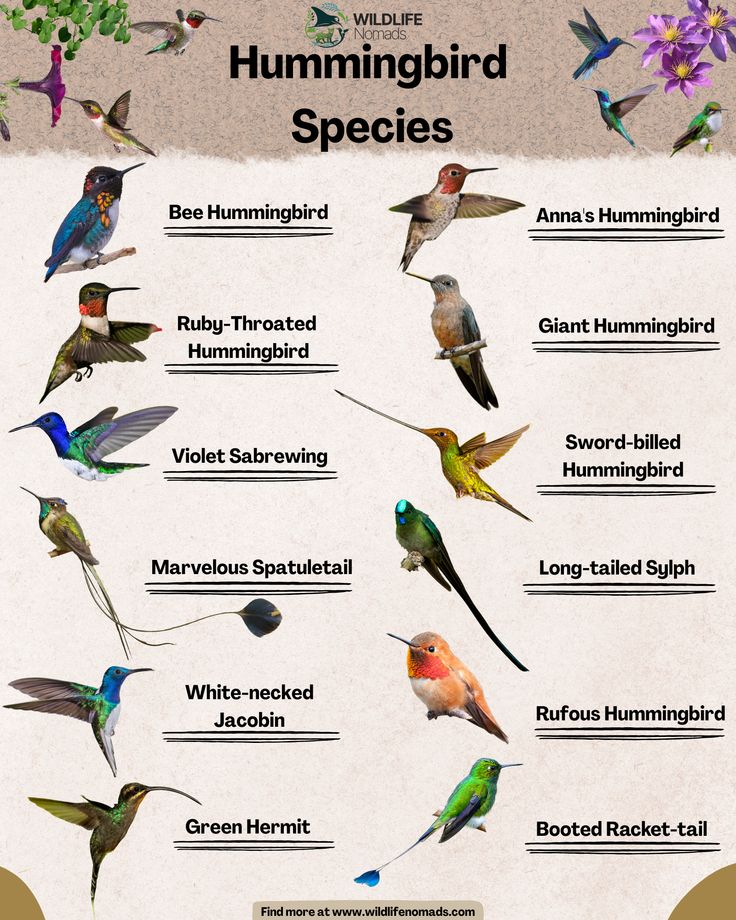
The physical scale of these birds dramatically dictates their metabolic survival strategy. On one end of the spectrum is the tiny Bee Hummingbird, universally recognized as the smallest bird in the world, tipping the scales at less than an American penny. On the opposite end sits the robust Giant Hummingbird, which moves with a noticeably slower, more deliberate wing beat reminiscent of a swift or a swallow, proving that even within a single avian family, nature optimizes size for different environmental niches.
2. Morphological Masterpieces: Specialized Adaptations for Survival
A close look at different hummingbird varieties reveals a breathtaking array of specialized physical traits designed to conquer specific environmental challenges and food sources.
Extraordinary Bills and Tail Feathers
Perhaps no bird showcases evolutionary specialization quite like the Sword-billed Hummingbird. It is the only bird in existence with a bill longer than its entire body, a unique adaptation that allows it to feed from incredibly deep, tubular passionflowers that other birds cannot reach. Meanwhile, species like the Marvelous Spatuletail and the Booted Racket-tail feature highly exaggerated, racket-like tail feathers used in complex aerial courtship displays to attract mates, proving that physical design serves both survival and social functions.
Intricate Plumage and Structural Color
The stunning, metallic glint seen on birds like the Violet Sabrewing, White-necked Jacobin, and Long-tailed Sylph isn’t actually caused by traditional pigmentation. Instead, it is the result of structural coloration. Microscopic structures within the feathers refract sunlight like a prism, causing the bird’s color to shift dynamically from dull charcoal to brilliant turquoise, emerald, or ruby depending entirely on the angle of the light.