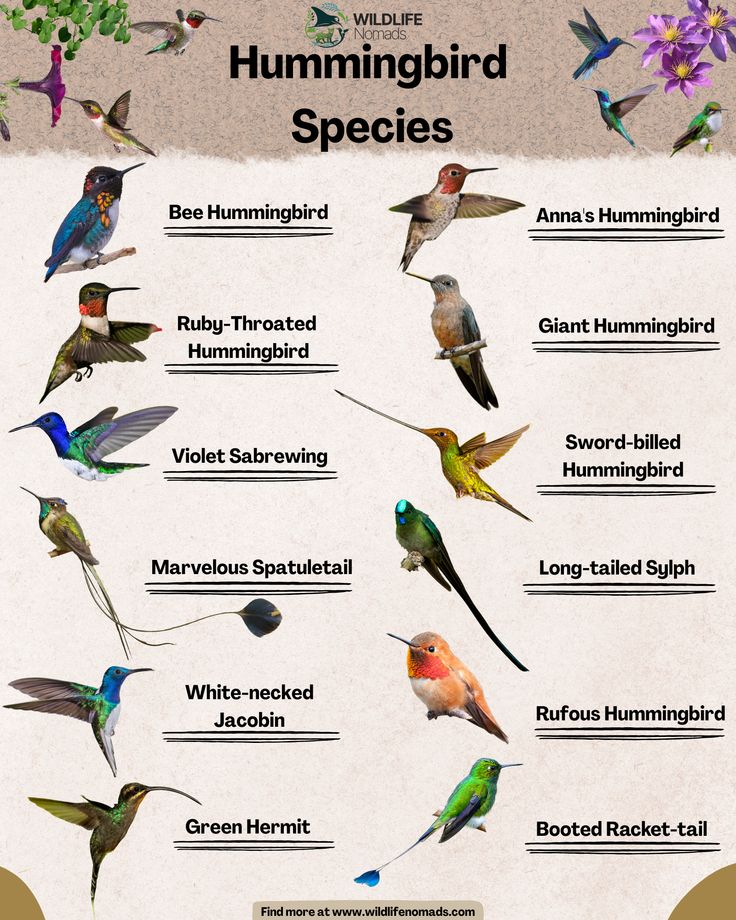
There are few sights in the natural world quite as mesmerizing as a hummingbird suspended in mid-air, its wings beating so rapidly they become a translucent blur. These tiny, iridescent jewels of the avian world are absolute marvels of evolutionary engineering, combining extreme agility with specialized adaptations that allow them to thrive across diverse ecosystems. An illustrative wildlife guide titled “Hummingbird Species” by Wildlife Nomads maps out an elite roster of these fascinating birds, highlighting unique varieties such as the Bee Hummingbird, Anna’s Hummingbird, Ruby-Throated Hummingbird, Giant Hummingbird, Violet Sabrewing, Sword-billed Hummingbird, Marvelous Spatuletail, Long-tailed Sylph, White-necked Jacobin, Rufous Hummingbird, Green Hermit, and Booted Racket-tail.
However, appreciating these remarkable creatures goes far beyond admiring their vibrant plumage. To truly understand hummingbirds, one must explore the fascinating biology that drives their high-energy lifestyles, their unique ecological roles, and how modern bird enthusiasts can sustainably support their local populations. In this comprehensive guide, we unpack the hidden mechanics of hummingbird survival, analyze the physical adaptations of standout species, and explore the financial and environmental benefits of maintaining a thriving backyard habitat.
1. High-Octane Biology: The Metabolism of a Tiny Powerhouse
Hummingbirds possess some of the most extreme metabolic rates of any warm-blooded animals on earth. To fuel their frantic wing beats—which can range from 50 to over 200 beats per second depending on the behavior—their bodies operate like miniature, high-performance engines.