In an era dominated by rapid digital scrolling, viral brain teasers have become far more than a casual internet trend. They serve as excellent, micro-sized cognitive workouts that challenge our analytical reasoning, optical precision, and patience. A classic example of this phenomenon is the popular fast-food algebraic puzzle featured in which uses playful illustrations of soda drinks, hamburgers, and French fries to construct a multi-layered logic problem.
At first glance, these visual riddles appear incredibly straightforward, tempting viewers to shout out an immediate, impulsive answer. However, the true value of these exercises lies in their hidden subtleties—the tiny visual shifts and mathematical rules designed to catch an inattentive mind off guard. In this comprehensive guide, we unpack the step-by-step mathematical logic required to crack the puzzle, explore the cognitive science behind optical awareness, and examine how cultivating a meticulous eye for detail translates directly into real-world professional and financial success.
1. Deconstructing the Equation: A Step-by-Step Mathematical Guide
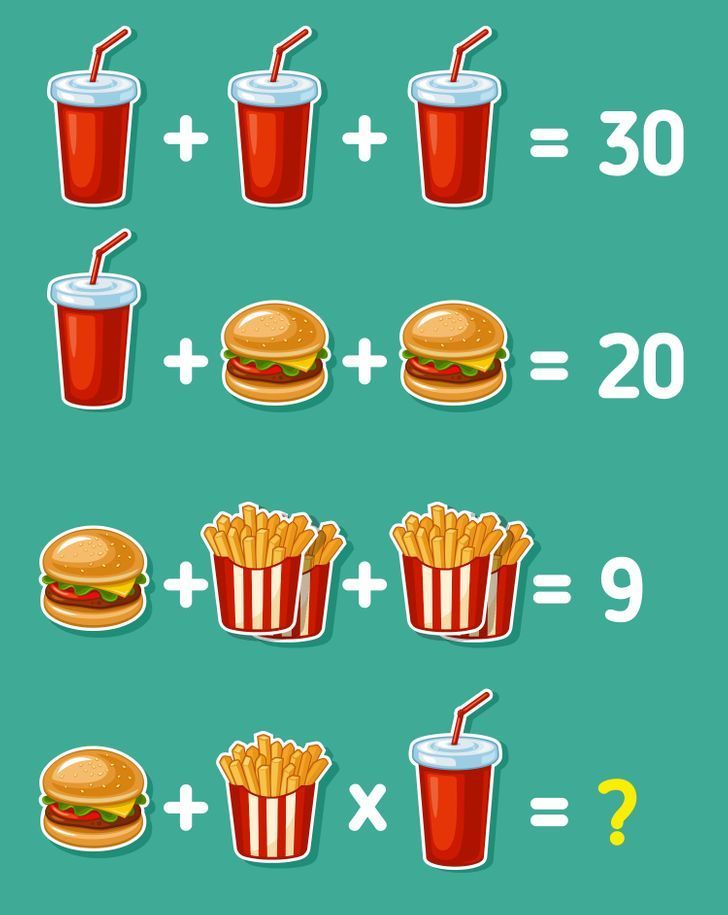
To arrive at the definitive solution for the riddle presented we must treat each row as a linear algebraic equation, isolating the value of each individual food item one step at a time.
Row One: Establishing the Baseline
The puzzle begins with a clean, triple-addition equation: three identical red soda cups with straws equal 30. Because all three variables are completely identical, we simply divide the total sum by three. This establishes a firm baseline value for our first variable:
- 1 Soda Drink = 10
Row Two: Introducing the Next Variable
The second row introduces a pair of classic cheeseburgers into the equation: one soda drink plus two identical burgers equals 20. Knowing from our first step that the drink represents a value of 10, we subtract that from the total sum of 20, leaving us with a remainder of 10. Dividing that remainder equally between the two remaining items reveals the value of our second variable:
- 1 Burger = 5
Row Three: The Subtle Visual Trap
This is where the vast majority of casual observers fail. The third row shows one burger added to two distinct packs of French fries, totaling 9. However, a closer look at the illustrations reveals that each group of fries in this row actually consists of two containers stacked closely together.
If we take the burger’s value of 5 and subtract it from 9, we are left with a value of 4 for the remaining items. Since there are two double-packs of fries, each double-pack holds a value of 2. Crucially, this means that a single, standalone container of fries has a specific value:
- 1 Double Fries Pack = 2
- 1 Single Fries Pack = 1
Row Four: Applying the Order of Operations
The final row presents the ultimate test, combining our isolated variables into a mixed operational string: one burger plus one single pack of fries multiplied by one soda drink. To solve this correctly, we must strictly apply standard algebraic rules of precedence, commonly known as PEMDAS (Parentheses, Exponents, Multiplication/Division, Addition/Subtraction). Multiplication must be executed before addition:
- Equation: 5 + 1 × 10 = ?
- Step 1 (Multiplication): 1 × 10 = 10
- Step 2 (Addition): 5 + 10 = 15
- Final Solution = 15
2. The Cognitive Science Behind Visual Efficiency
Why do so many intelligent adults answer these seemingly simple puzzles incorrectly on their first attempt? The answer lies in how the human brain processes familiar visual patterns.
The Pitfall of Heuristic Processing
To save metabolic energy, the human brain relies heavily on mental shortcuts called heuristics. When looking at a graphic like the one , your visual cortex immediately recognizes the general shapes of “fries” and “burgers” and assumes they remain identical throughout the entire image. It requires deliberate, conscious focus to override this passive processing mode and spot the missing second fry container in the final row or notice the sudden switch from an addition sign to a multiplication sign.