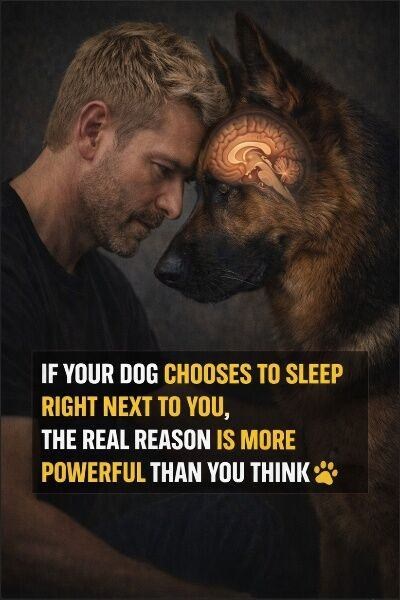
If Your Dog Chooses to Sleep Right Next to You, the Real Reason Is More Grounded—and More Interesting—Than Viral Posts Suggest
Headlines like “If your dog sleeps next to you, the reason is more powerful than you think” spread quickly online because they tap into something almost every dog owner experiences. At some point, many people notice their dog consistently choosing to sleep right beside them—curled up at their feet, pressed against their legs, or even resting their head on the bed near their owner’s body.
Posts like this often hint at a dramatic or mysterious explanation: emotional secrets, hidden intelligence, or symbolic meanings. But the real reasons are less mystical and far more rooted in behavior science, domestication history, and everyday canine instincts.
To understand why dogs behave this way, it helps to look at both the emotional bond between humans and dogs and the evolutionary habits that still shape their behavior today.
A Viral Claim That Sounds Mysterious but Isn’t Scientific
The idea that a dog sleeping next to its owner reveals a “deep hidden truth” is a common social media trope. It suggests that dogs choose sleeping positions based on secret emotional readings of their humans or symbolic meanings tied to loyalty, protection, or spiritual connection.
While it’s true that dogs are emotionally sensitive animals, there is no scientific evidence supporting the idea that sleeping position reveals hidden psychological “messages” about the owner.
Instead, animal behavior research shows that dogs choose sleeping locations based on comfort, security, temperature, bonding, habit, and learned routines.
The behavior is meaningful—but not mystical.
Why Dogs Naturally Seek Physical Proximity
Dogs are social animals. Long before they became household pets, their ancestors lived in structured packs where physical closeness provided safety and stability.
Modern domestic dogs still retain many of these instincts. Sleeping near another member of their “social group”—which often includes humans—helps them feel secure.
This behavior is strongly tied to domestication. Over thousands of years, dogs evolved alongside humans, developing a unique ability to interpret human emotions and integrate into human households.
In a home environment, the “pack” becomes the family, and the dog often forms a primary attachment to one or more individuals.
So when a dog chooses to sleep next to a person, it is often expressing a basic social instinct: staying close to a trusted companion.
Comfort and Security: The Most Important Factors
One of the simplest explanations is also the most overlooked: comfort.
Dogs tend to sleep where they feel physically and emotionally safe. A human owner provides:
Warmth from body heat
A stable and familiar presence
A predictable environment
Reduced perceived threats
In evolutionary terms, sleeping near a larger companion increases survival chances. Even though domestic dogs no longer face wild predators, these instincts remain embedded in their behavior.
Many dogs also experience separation discomfort when away from their primary caregiver. Sleeping nearby reduces that feeling and helps them relax more deeply.
This is not dependence in a negative sense—it is a reflection of strong social bonding.
Bonding and Emotional Attachment
Research in animal cognition has shown that dogs form strong attachment bonds with humans, similar in some ways to infant-caregiver relationships.
When a dog chooses to sleep next to a person, it may simply be seeking emotional closeness with someone it trusts deeply.
This attachment is reinforced through daily routines:
Feeding times
Walks and exercise
Play and training
Affection and attention
Over time, the dog learns that the owner is a consistent source of safety and positive experiences. Sleeping nearby becomes a natural extension of that bond.
However, this does not mean the dog is “reading emotions in a supernatural way” or assigning symbolic meaning. It is responding to familiarity and learned trust.
Temperature and Physical Comfort
Another very practical reason dogs sleep close to humans is warmth.
Dogs regulate body temperature differently depending on breed, coat type, and environment. Many dogs naturally seek warm spots to rest, and a human body provides a steady source of heat.
This is especially noticeable in:
Small dog breeds
Short-haired dogs
Older dogs with reduced temperature regulation
Cold environments or winter seasons
Even larger dogs may choose to sleep nearby simply because it feels comfortable and cozy.
What may seem like an emotional gesture is often just a biological preference for warmth and softness.
Territorial Behavior and “Guarding” Instincts
Some dogs sleep next to their owners not only for comfort, but also due to protective instincts.
Dogs have an innate tendency to monitor their environment and respond to potential changes or threats. Sleeping close to a human allows them to:
Stay alert to movement or sound
Respond quickly if something changes
Maintain proximity to a perceived “pack leader”
This behavior is more pronounced in certain breeds that were historically developed for guarding or herding roles.
However, this does not mean the dog believes danger is present. It simply reflects an inherited pattern of vigilance combined with attachment.
Habit and Routine: Dogs Learn Patterns Quickly
Dogs are highly routine-oriented animals. Once a sleeping arrangement becomes familiar, they are likely to repeat it.
If a dog is allowed to sleep next to its owner even a few times, it may quickly learn:
This is a safe place
This is part of the nightly routine
This location is comfortable and rewarding
As a result, the behavior becomes habitual.
Over time, what began as a choice based on comfort or curiosity becomes a consistent pattern reinforced by repetition.
This is why many owners notice that once their dog starts sleeping beside them, it is difficult to change the behavior later.
Breed Differences in Sleeping Preferences
Not all dogs behave the same way when it comes to sleeping arrangements.
Some breeds are naturally more independent, while others are more people-oriented. For example:
Companion breeds often prefer close physical contact
Working or guard breeds may alternate between proximity and distance
Highly independent breeds may choose separate sleeping areas
These tendencies are shaped by selective breeding over generations, which influences temperament and social behavior.
However, individual personality also plays a major role. Even within the same breed, dogs can have very different preferences based on experience and upbringing.
The Role of Early Life Experiences
A dog’s early environment strongly influences its sleeping habits later in life.
Puppies raised in close contact with humans are more likely to:
Seek physical closeness
Prefer sleeping near people
Show stronger attachment behaviors
Conversely, dogs raised with more independent sleeping arrangements may prefer their own space as adults.
These early experiences shape what the dog perceives as normal and safe.
So if a dog consistently chooses to sleep next to its owner, it may simply be continuing a pattern learned early in life.
Why Viral Posts Misinterpret This Behavior
Social media often turns normal animal behavior into something dramatic or symbolic. Claims like “your dog sleeps next to you because you are its chosen protector” or “because it senses your emotional energy” are designed to be emotionally appealing rather than scientifically accurate.
While dogs are indeed emotionally intelligent and responsive to human behavior, their actions are best understood through:
Evolutionary biology
Behavioral conditioning
Social bonding
Environmental comfort
Not mystical interpretation or hidden meanings.
The reality is both simpler and more fascinating than viral posts suggest: dogs have evolved alongside humans to form close, cooperative relationships based on trust and mutual benefit.
When Sleeping Behavior Might Change
Although sleeping close to an owner is usually normal, changes in sleeping behavior can sometimes reflect shifts in a dog’s health or emotional state.
For example, a dog might suddenly stop sleeping nearby due to:
Heat or discomfort
Stress or environmental changes
Age-related mobility issues
Noise or disturbances
Changes in household routine
On the other hand, increased closeness may sometimes indicate a desire for reassurance during stressful periods.
Understanding these shifts requires observing the broader context rather than focusing on a single behavior in isolation.
The Human Side of the Bond
It is also worth acknowledging the human perspective. Many owners feel comforted when their dog sleeps next to them. The presence of a dog can reduce feelings of loneliness, increase emotional comfort, and create a sense of routine and security.
This mutual benefit strengthens the bond between humans and dogs over time.
However, this emotional connection does not require symbolic explanations. It is built on shared daily life, trust, and companionship.
A Look at Canine Attachment Science
Studies in animal behavior have shown that dogs often display attachment patterns similar to those seen in young children. When separated from their owners, many dogs show signs of mild stress, which decreases when the owner returns or is nearby.
This attachment system is part of what makes dogs such successful companions for humans. They are uniquely tuned to social bonding with another species.
So when a dog sleeps next to its owner, it is participating in a deeply rooted attachment behavior that has been shaped over thousands of years of domestication.
Conclusion: A Simple Behavior With a Real Meaning
The idea that a dog sleeping next to you reveals something mysterious or “more powerful than you think” is an exaggeration. But the real explanation is still meaningful.
When a dog chooses to sleep beside its owner, it is usually expressing:
Comfort
Trust
Social bonding
Habit
Warmth-seeking behavior
Natural pack instincts
These are not hidden secrets—they are well-understood aspects of canine behavior.
domestic dog has evolved alongside humans for thousands of years, developing a unique ability to live closely with people and form strong emotional attachments. Sleeping near a human is one of the clearest expressions of that relationship.
In the end, the behavior is not mysterious at all. It is a quiet reminder of something very real: dogs don’t just live near us—they choose to be close to us because, in their world, we are their trusted social partners.
And that, without any exaggeration, is already powerful enough.